Guides
Buddhist marriage biodata format (with sample)
Most standard biodata templates assume a Hindu page, with Shree Ganesh at the top and a kundli section in the middle, and neither fits a Buddhist family. This Buddhist marriage biodata format covers the headings families actually use, the fields in order, how Ambedkarite families in Maharashtra and elsewhere usually handle horoscope and caste, and a complete sample.
- Common headings are “Namo Buddhaya”, “Jai Bhim”, both together, or a Dharma wheel emblem.
- Most Ambedkarite Buddhist biodatas have no horoscope section.
- Many families write only “Buddhist” for religion; caste is optional.
- A line on practice, such as visiting the vihara, is common and helpful.
- Marathi and Hindi are widely used alongside English.
Choosing the heading
| Heading | Written as | When families use it |
|---|---|---|
| Namo Buddhaya | नमो बुद्धाय | The most common opening, in any language |
| Jai Bhim | जय भीम | Ambedkarite families, often together with Namo Buddhaya |
| Both | नमो बुद्धाय · जय भीम | Very common in Maharashtra and Vidarbha |
| Pali salutation | Namo Tassa Bhagavato Arahato Sammāsambuddhassa | Families who recite Buddha vandana regularly |
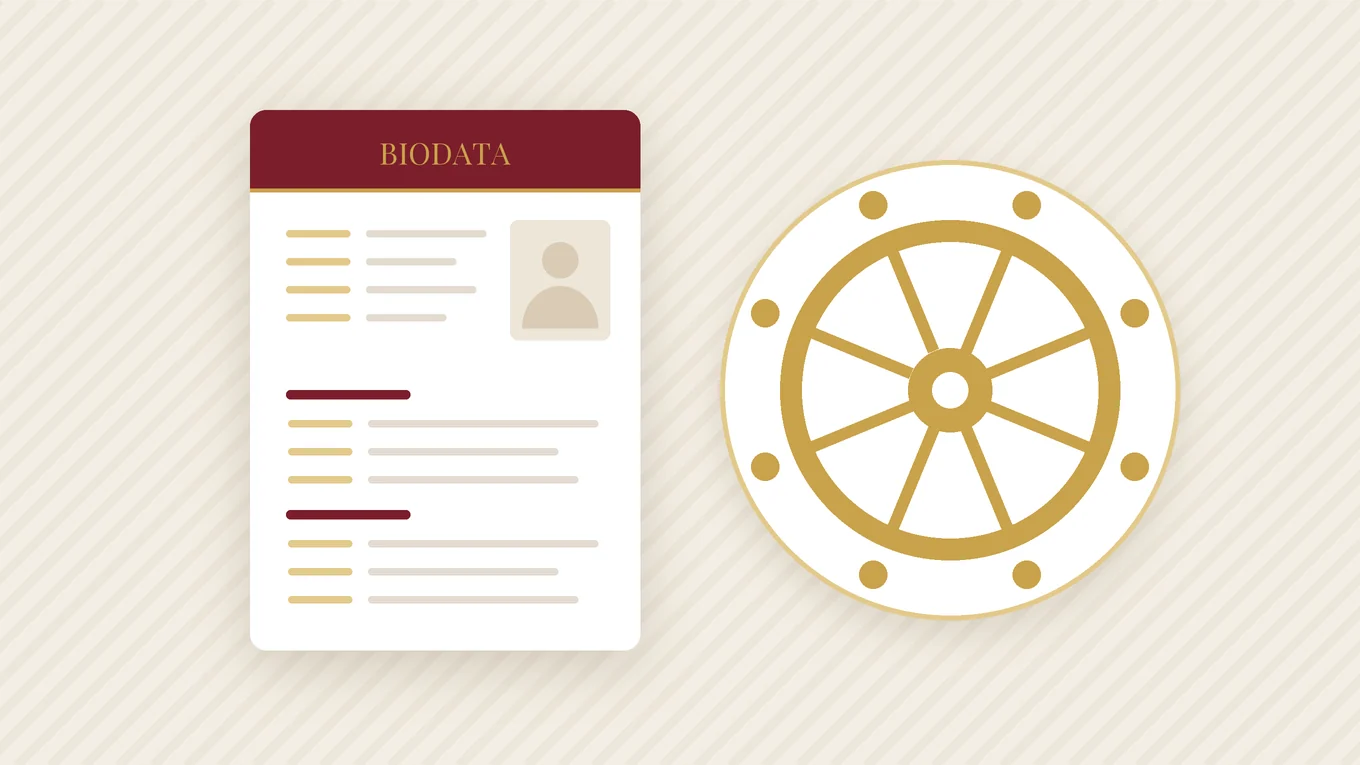
| Dharma wheel emblem | The eight-spoked wheel, no text | A clean option for English biodatas |
Pick one line, or the wheel with one line under it. Some families also place a small image of the Buddha or of Dr. Babasaheb Ambedkar at the top; on a one-page biodata, a single emblem looks tidier.
Fields in order
| Section | What to include |
|---|---|
| Personal details | Name, date of birth, height, marital status, mother tongue, city, diet |
| Religion | Buddhist; tradition if relevant; a line on practice |
| Education & career | Degree and college, occupation, employer, city, income range |
| Family | Parents with occupations, siblings, native place, family type |
| About me | Three or four lines in your own words |
| Partner preferences | Age range, education, religion or openness, location |
| Contact | Parent’s name and number |
These are the same core sections as any marriage biodata format. The difference is mainly what you leave out: a kundli section and a Hindu religious heading.
Horoscope: usually left out
Most Ambedkarite (Navayana) Buddhist families do not use kundli matching, and their biodatas carry no rashi, nakshatra, gan or manglik fields. Date of birth is still written, as in any biodata, because it gives age. If your family does consult a horoscope, add date, time and place of birth, but it is not expected.
Buddhist families in Ladakh, Sikkim, Darjeeling, Arunachal Pradesh and among Tibetan communities follow their own customs, which can include consulting a lama about dates. If that is your family’s practice, write what the other family would need to know in one line.
Religion and practice
Write “Buddhist” (बौद्ध). If tradition matters, add it in brackets: Navayana, Theravada, Mahayana or Vajrayana. Then one line on how you practise gives the other family a real sense of daily life:
Examples
Buddhist; attends Buddha vandana at the local vihara on Sundays · Buddhist (Navayana); has completed a 10-day Vipassana course · Buddhist; family visits Deekshabhoomi every Dhammachakra Pravartan Din
Write what you actually do. A line that sounds more devout than your routine will come up in the first conversation.
Caste: your family’s choice
The Ambedkarite Buddhist movement rejects caste, and many families write only “Buddhist” with no caste line at all. Some families do mention an earlier community identity because their relatives and matchmaking networks still use it. Both happen, and neither needs a note of explanation.
Most common
Religion: Buddhist
Open preference
Partner preferences: … from a Buddhist family; caste no bar
Open across religions
Partner preferences: … progressive, educated family; religion and caste no bar
More on this wording in caste and gotra in a marriage biodata.
The wedding: Buddhist vivah or Dhamma vivah
A Buddhist wedding in the Ambedkarite tradition is usually a simple ceremony before an image of the Buddha and a portrait of Dr. Ambedkar. A bhante or a Bauddhacharya leads the Buddha vandana, the Trisharan and the Panchsheel, and the couple take their vows. Invitations in Marathi often use “मंगल परिणय” rather than “शुभ विवाह”, and prefix names with “आयु.” for the groom and “आयुनी” for the bride.
None of this needs to be on the biodata. If your family has a preference, one line in partner preferences is enough: “Wedding by Buddhist rites (Dhamma vivah) preferred.”
Marathi and Hindi terms
| English | Marathi | Hindi |
|---|---|---|
| Religion: Buddhist | धर्म: बौद्ध | धर्म: बौद्ध |
| Date of birth | जन्मतारीख | जन्म तिथि |
| Education | शिक्षण | शिक्षा |
| Occupation | नोकरी / व्यवसाय | व्यवसाय |
| Father’s name | वडिलांचे नाव | पिता का नाम |
| Native place | मूळ गाव | मूल निवास |
| Partner expectations | अपेक्षा | जीवनसाथी से अपेक्षाएँ |
The Marathi marriage biodata page has a full format in Devanagari. The Marriage Biodata Maker app offers a Dharma wheel emblem and 13 languages, including Marathi and Hindi.
Sample Buddhist marriage biodata
नमो बुद्धाय · Biodata — Prajakta Meshram
Personal details
| Date of birth | 3 January 1998 |
| Height | 5′ 3″ |
| Marital status | Never married |
| Mother tongue | Marathi |
| Diet | Non-vegetarian |
| Lives in | Nagpur, Maharashtra |
Religion
| Religion | Buddhist |
| Practice | Attends Buddha vandana at the local vihara on Sundays; has completed a 10-day Vipassana course |
Education & career
| Education | M.Sc. Microbiology, RTM Nagpur University |
| Occupation | Senior Lab Technologist, a diagnostic laboratory, Nagpur |
| Income | ₹4 – 5 Lakh per annum |
Family
| Father | Anil Meshram — retired Section Engineer, Central Railway |
| Mother | Sunanda Meshram — primary school teacher |
| Siblings | One younger brother, B.E. final year |
| Native place | Bhandara, Maharashtra |
| Family type | Nuclear |
About me
| I run tests in a diagnostic lab and am studying for a certificate in quality management. I read Marathi novels, sing in our vihara’s youth group and enjoy trekking with friends. I am close to my parents and value education, honesty and equal respect in a marriage. |
Partner preferences
| Age 27–31, postgraduate or professionally qualified, from a Buddhist family. Nagpur or Pune preferred. Progressive, kind and supportive of my career. Caste no bar. |
Contact
| Father | Anil Meshram — 94XXXXXX18 |
Sample only — all names, dates and numbers are invented.
Want it designed?
Make it in the app in a minute — 19 designs, 13 languages, a print-ready PDF.
Last updated 28 September 2026 · Biodata for Marriage team
Frequently asked questions
What is written at the top of a Buddhist marriage biodata?
Do Buddhist biodatas include a horoscope?
Should caste be mentioned in a Buddhist biodata?
What is a Dhamma vivah?
Make your biodata in the next 10 minutes
Free to start. Classic Frame in all 13 languages, no sign-up.
Get the free app