Getting started
Marriage biodata vs matrimony profile: the differences, and when you need each
You have a profile on a matrimony site, and still a relative asks, “Send the biodata.” They are not the same thing, and one does not replace the other. Here is marriage biodata vs matrimony profile compared point by point — who reads each, what goes in — and how to turn one into the other without starting from scratch.
- A biodata is a one-page document families forward; a profile is a searchable listing that strangers filter.
- A biodata carries facts, one photo and a parent’s number; a profile carries more photos, a longer About Me and contact through the site.
- A site gives you privacy controls; a forwarded biodata is out of your hands.
- Keep both, built from the same facts, and update them on the same day.
The short answer
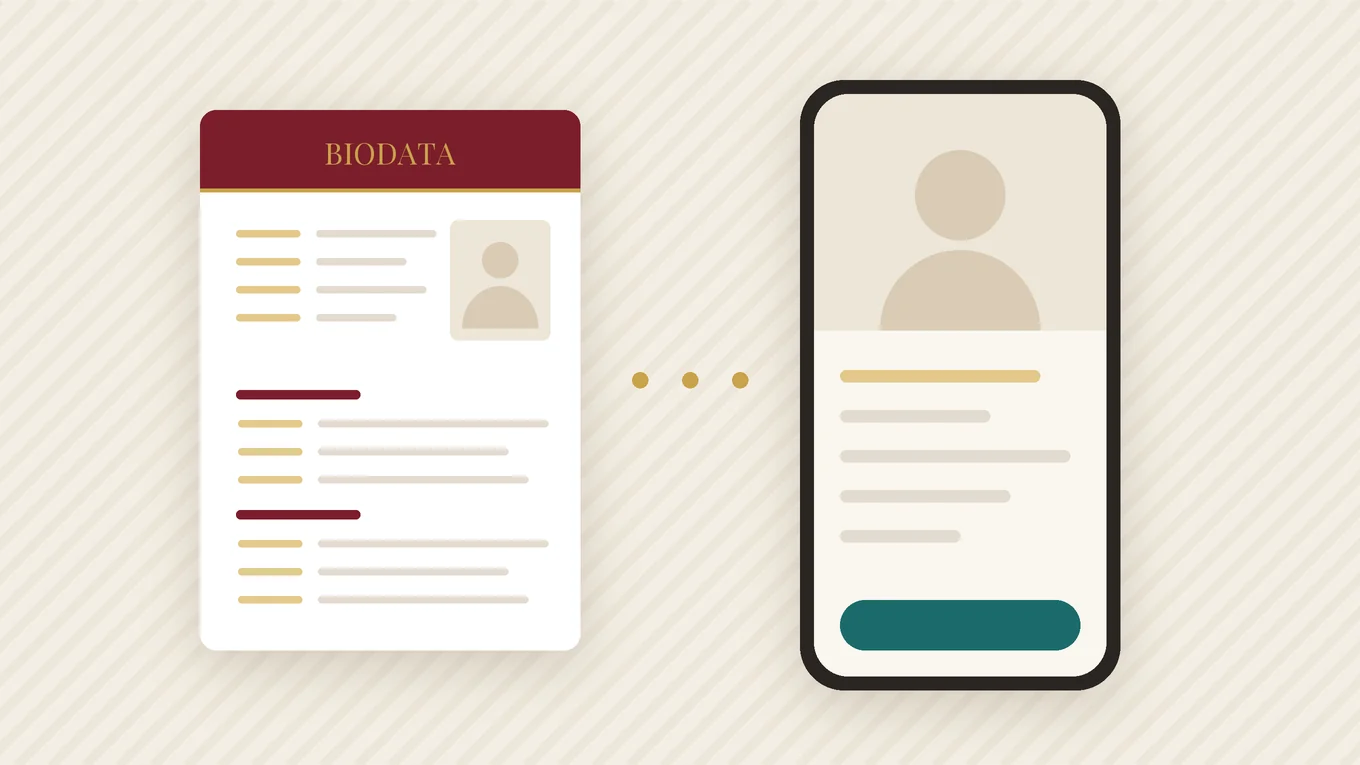
A marriage biodata is a one-page PDF, usually made by the family, passed hand to hand — WhatsApp, relatives, matchmakers, community groups. A matrimony profile is an account on a website or app such as Shaadi.com, Jeevansathi or BharatMatrimony, or a community site, where people search with filters and contact you through the site.
They do different jobs. The profile helps strangers find you. The biodata helps people who have already heard of you — through a relative, a matchmaker or a match on a site — decide whether the families should talk.
Side by side
| Marriage biodata | Matrimony profile | |
|---|---|---|
| Who reads it first | Parents, relatives, matchmaker, sometimes an astrologer | Usually the prospective partner, or a parent searching on the site |
| How it is found | Someone refers it or forwards it | Search filters: age, city, education, community |
| Length | One A4 page | Many fields across several screens |
| Tone | Short, factual lines | First person, conversational About Me |
| Photos | One | Several, with visibility settings on many sites |
| Contact | A parent’s number printed on the page | Through the site; number shown depending on settings or membership |
| Privacy | Anyone can forward it, anywhere | Block, report, hide the profile, limit who sees photos |
| Verification | Through the person who referred it and the community | Many sites verify phone numbers and some offer ID checks; the rest is self-declared |
| Horoscope | A full section, if the family follows it | A few fields; some sites offer a horoscope match |
| Cost | Free to share | Free to create; contacting people often needs a paid plan |
Why families still ask for a PDF biodata
- Elders are not on the site. A grandmother or a mama will read a PDF on WhatsApp; they will not log in to an account.
- It can be printed and carried to the family priest, an astrologer or a community meet.
- It makes comparison easy. When three proposals are being discussed, parents like the same one-page layout side by side.
- Family details are fuller. Profiles keep family short; a biodata gives parents’ work, siblings and native place, which elders ask about first.
- It can be in the family’s language. A Marathi, Tamil, Urdu or Hindi biodata suits elders who read English slowly; see biodata in your language.
- Conversations move off the site. Once two families start talking, it moves to WhatsApp, and the biodata is what gets forwarded to the rest of the family.
Turning a matrimony profile into a biodata
| Profile section | What it becomes on the biodata |
|---|---|
| Basic details | Personal details — date of birth instead of age; height, religion, mother tongue, marital status, city |
| Education and career | Degree and college, job title, employer, city; income as a range |
| Family details | Expand: parents’ occupations, siblings with work and marital status, native place, family type |
| Astro details | Horoscope section with birth time and place, rashi, nakshatra, gotra, manglik — or delete it |
| About me (long) | Cut to 40–70 words |
| Hobbies and interests tags | One line inside About Me |
| Lifestyle | Diet in personal details; smoking and drinking only if your family expects it |
| Partner preference filters | Three or four lines: age range, education, location, one line on values |
| Photo gallery | One recent shoulders-up photo |
| Contact via site | A parent’s name and number |
Profile About Me (too long for a biodata)
Hi, thanks for visiting my profile. I’m a pretty easy-going person who believes in keeping things simple. I work as a product designer at a fintech startup in Bengaluru, which keeps me busy but I love it. On weekends you’ll find me trekking around Coorg or trying new cafés with friends. I’m close to my parents and my younger brother. Looking for someone who is kind, honest and has a good sense of humour, and who values family as much as I do.
The same, cut for a biodata
Product designer at a fintech company in Bengaluru. I trek in Coorg when I can, try new cafés with friends and am close to my parents and younger brother. I value kindness, honesty and a sense of humour.
Turning a biodata into a matrimony profile
- Expand About Me in the first person: what your work involves, what a normal weekend looks like, what you hope for. Strangers have no referral to fill the gaps. The About Me guide has examples.
- Add three to five photos: a clear portrait, a full-length photo, and one natural photo at an event or outdoors.
- Set preferences honestly but not narrowly. They shape the matches the site shows you; a height or income filter set too tight hides people you would have liked.
- Do not type your phone number into About Me. It gets around the site’s contact controls, and anyone who views the profile can copy it.
- Keep every fact identical to the biodata: height, degree, income range, date of birth. Families compare the two.
Privacy: the biggest practical difference
A biodata sent to one family can reach dozens of phones within a day, and you cannot take it back. On a site you can block someone, report a fake profile, hide your profile while talks are on, and choose who sees photos.
So make two versions of the biodata: a full one for families you have spoken to, and one without the phone number for large groups. Adding your matrimony profile ID to the biodata lets families see more photos, but it also links a forwarded PDF to your account — put it only in the full version.
Do you need both?
If your family mostly finds matches through relatives, a matchmaker or your community, a good biodata may be all you need. If you are relying on a site, keep a biodata ready anyway: the moment families start talking, someone will ask for it.
Either way, keep one list of facts and update both on the same day when you change jobs or cities. If you keep the biodata in an app such as Marriage Biodata Maker, it stays on your phone, so you can change a line and export a fresh PDF in a minute.
Want it designed?
Make it in the app in a minute — 19 designs, 13 languages, a print-ready PDF.
Last updated 29 September 2026 · Biodata for Marriage team
Frequently asked questions
What is the difference between a biodata and a matrimony profile?
Can I send my Shaadi.com profile link instead of a biodata?
Should I put my matrimony profile ID on my biodata?
Is a matrimony profile safer than a biodata?
Should the details in my biodata and profile match?
Related guides
Getting started
What is a marriage biodata? Meaning, contents and how families use it
Getting started
How to make a marriage biodata (step by step, with sample)
Writing
About me in a marriage biodata: 20 examples for girls and boys
Getting started
How to send a marriage biodata on WhatsApp (without losing quality)
Make your biodata in the next 10 minutes
Free to start. Classic Frame in all 13 languages, no sign-up.
Get the free app